The UK Maritime & Coastguard Agency published MGN 681 Amendment 1 on 19 December 2025, setting new mandatory requirements for lithium battery storage and charging on yachts. With the 1 January 2027 deadline for UK Type Approval now just 12 months away, yacht owners and crew need to make clear decisions about compliance, and LiVault’s systems are already engineered to meet, and go beyond, the new standard.
Key Updates in MGN 681 Amendment 1 for Yacht Safety
The amendment introduces eight functional requirements for battery charging cabinets that move far beyond simple fire resistance. Sections 4.12–4.13 now require:
- Charging capability while the cabinet remains closed
- Temperature rise detection with automated alert systems
- Application of an extinguishing medium without opening the cabinet
- Off-gas venting to prevent explosive gas build-up
- Fire insulation and explosion-resistant construction
- Automatic charging shutdown on fault or overheating
- Defined and validated maximum capacity limits (kWh)
- Insulation to prevent fire spread
- Certification from a nominated body
All battery storage and charging containers must obtain UK Type Approval by 1 January 2027, and the MCA recommends replacing existing systems with approved solutions even if they were installed before that date.
Why LiVault Meets MGN 681 Amendment 1 Standards
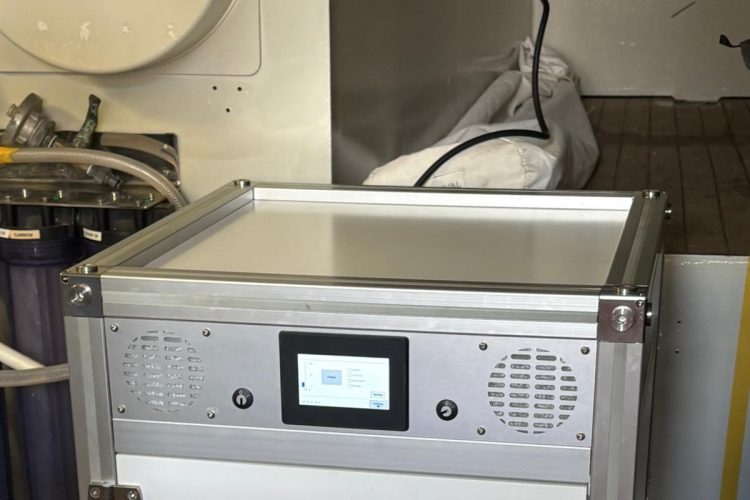
Built in the EU by TechnoPhysik, a specialist in fire protection solutions, RAMBSS and RACLAN were conceived as active safety systems rather than passive storage boxes. Where Amendment 1 sets out the functional requirements, these systems deliver them in practice:
- A multi-nozzle cooling system using “Trident” concentrate allows suppression without opening the cabinet.
- Intelligent thermal management continuously monitors temperature, with alarms and automatic charging shutdown in the event of a fault.
- Toxic fume multi-stage filtration system that filters or absorbs HF, VOCs, and H2. This prevents toxic or explosive substances from escaping.
- Ballistic composite construction with blast buffering elements provides explosion protection beyond conventional fire-resistant enclosures.
- Testing and validation from TUV and RICE Institute of Sweden, who are accredited test bodies for Lloyds and DNV.
The systems integrated charging infrastructure and monitoring allow effective battery management while the cabinet stays sealed, reflecting the layered approach of detection, automated response, containment, filtration and cooling envisaged in Amendment 1.
The Competitive Difference
Conventional passive storage systems are prevalent in the market, but they cannot meet Amendment 1’s functional requirements. Cabinets certified only to EN 144701 were developed for fixed industrial settings for flammable materials, not batteries, and not for managing thermal runaway hazards in a marine environment with vibration, saltwater exposure and confined spaces.
| Requirement (MGN 681(M) 4.12-4.13) | RAMBSS & RACLAN Implementation | Passive Cabinet Limitation |
| Charging while closed | Integrated charging infrastructure | Typically requires opening for battery access |
| Temperature monitoring & alerts | Intelligent thermal management with alert systems, automatic charging cessation on fault | Basic temperature sensors without active response |
| Extinguishing medium application without opening | Multi-nozzle cooling system with “Trident” concentrate, external water connections for internal flooding | Manual firefighting required after detection |
| Off-gas venting | Particularly effective exhaust with multiple filter systems, integrated ventilation for toxic fume filtration | Passive venting without filtration |
| Explosion protection | Ballistic composite construction with blast buffering elements | Standard fire-resistant materials |
The Path Forward
With a year to go before the Type Approval deadline, owners effectively have two options: install a purpose-built active safety system designed to meet and exceed MGN 681 Amendment 1 or face a last-minute rush to retrofit as enforcement begins.
The regulatory framework has moved on to provide clear and achievable guidelines. RAMBSS and RACLAN were built with these requirements, and the next generation of yacht operations, in mind.