Palma 2026: The Year Lithium-ion Safety Can No Longer Be Ignored
The Superyacht industry arrives at Palma International Boat Show 2026 at a Lithium-ion safety inflection point. A sequence of high-profile vessel losses, a landmark regulatory update from the UK Maritime and Coastguard Agency, and increasingly explicit Lloyd’s insurance clauses have converged to make lithium-ion (Li-ion) battery storage and charging safety the defining issue of this season. For captains, engineers, technical managers and yard operators gathering in Palma from 29 April to 2 May, the question is no longer *whether* to treat Li-ion risk seriously – it is whether current arrangements are genuinely compliant and insurable.
An Incident Record That Demands Attention
The record is stark. In early 2025, M/Y Naisca IV* burned to the waterline near Marseille, with early investigations identifying a lithium-ion battery as the probable ignition source. Months earlier, the US National Transportation Safety Board published its final report on Flagship, a VisionF 82 catamaran lost in a Miami repair yard in April 2024. The NTSB’s conclusion was unambiguous: thermal runaway and subsequent explosion in the vessel’s 24-volt Li-ion battery bank, triggered by a disabled Battery Management System and the consequent use of an unauthorised portable charger to individually charge cells. Total asset loss: $5 million.
These incidents are not anomalies. According to the International Union of Marine Insurance (IUMI), lithium battery incidents now represent a growing share of total yacht fire losses globally, and the severity per incident exceeds that of traditional fire causes due to the speed and toxicity of thermal runaway events.
Why Thermal Runaway Is a Different Problem
Thermal runaway is not a standard combustion event. Once a Li-ion cell enters runaway, an exothermic chain reaction becomes self-sustaining: internal temperatures can exceed 700°C, and adjacent cells are rapidly driven into runaway in turn, a cascading failure mode. Critically, the off-gases are acutely toxic. Hydrogen fluoride (HF), carbon monoxide and a range of volatile organic compounds are released at concentrations that can reach dangerous levels within minutes in enclosed spaces. HF at concentrations above 25 ppm represents a serious inhalation risk within short exposure windows, and standard smoke detectors, calibrated for particulate thresholds typical of burning fabric or wood may not trigger before toxic concentrations build.
This is why conventional passive fire protection, including generic fireproof bags and standard CO₂ extinguishers, is now considered insufficient by regulators and insurers. CO₂ can suppress surface flame but does not interrupt the electrochemical reaction occurring inside the cell. Verified containment, gas management, monitoring and automatic suppression are now the expected standard.
MGN 681 (M) Amendment 1: What Changed and When
On 19 December 2025, the MCA published MGN 681 (M) Amendment 1, the most significant update to Li-ion battery guidance for the commercial and charter yacht sector since the original note. The amendment clarifies and tightens requirements for any yacht carrying electrically powered personal watercraft, e-foils, electric tenders, seabobs, jet skis with batteries rated above 100 Wh, aligning with REG Yacht Code Part A, Chapter 14.
Eight functional requirements for storage and charging containers are now defined in Sections 4.12–4.19 of the updated guidance, covering: fireproof construction, ventilation to atmosphere, active detection (smoke, heat, gas), automatic suppression, overpressure relief, power isolation, and continuous monitoring capability. From 1 January 2027, storage and charging containers must be Type Approved by a MCA Nominated Body, and all batteries above 100 Wh must carry third-party conformity certification to IEC 62619 and/or IEC 62620.
Eight months sounds adequate. For most vessels currently in service, it is not. Type approval pipelines are constrained, existing arrangements on many yachts do not approach these requirements, and the refit window available to affected vessels before the deadline is narrowing.
The Insurance Dimension: JHC Clause JH2024-011A
Regulatory compliance and insurability are now directly linked. The Lloyd’s Joint Hull Committee introduced Lithium Battery Clause JH2024-011A as a condition precedent to underwriter liability for any loss caused by fire or explosion involving lithium batteries rated above 100 Wh. The clause requires, among other provisions, that any Lithium-ion battery be charged only inside a compliant Container, as defined in the REG Yacht Code or a space meeting those requirements, and that charging be monitored for fire, temperature, smoke and charge status at all times. The JHC has also confirmed that vessels without documented compliance risk claim denial or policy non-renewal. As of 2026, insurers are actively scrutinising battery management practices at survey.
The Only Verified Container: RAMBSS by LiVAULT
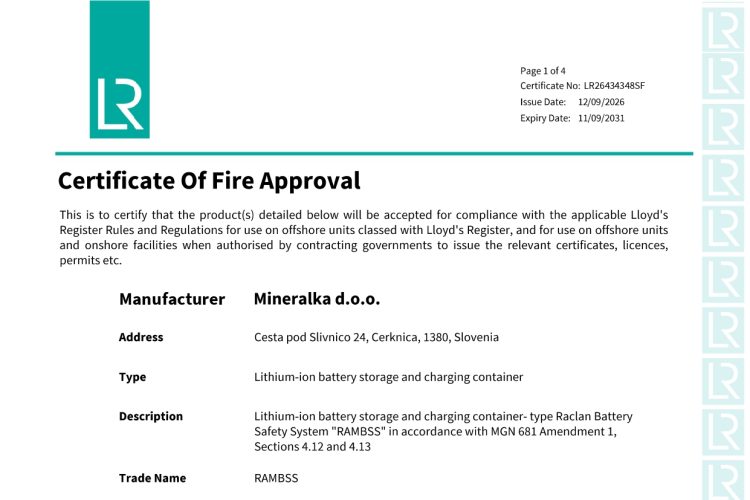
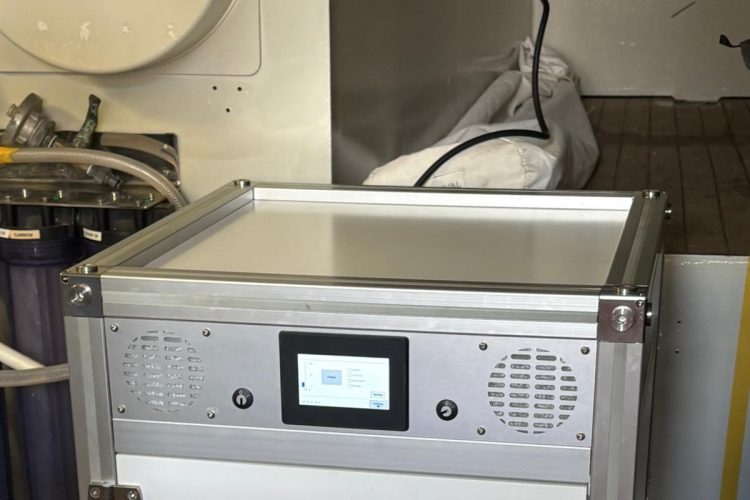
RAMBSS – the Raclan Maritime Battery Safety System – has been tested by the RI.SE. Institute in Sweden to the international standard UL 1487and Lloyd’s Register is now working on full type approval to MGN 681 (M). The system integrates:
– Fireproof composite housing – independently tested by RI.SE.
– Trident® automatic suppression – activating on thermal detection without crew intervention
– Multi-stage HF gas filtration – tested at a maximum 95 ppm inlet, with a sustained sub-34 ppm exhaust over a 15-minute interval
– 90-day emergency power supply – keeping safety systems operational after main power loss
– Overpressure relief valve – preventing explosive decompression in sealed compartments
Palma 2026: The Deadline Is Now Visible
Palma is the Western Mediterranean’s most important concentration of refit, management and operational yachting infrastructure. The 2026 show is the practical moment when the January 2027 compliance clock becomes operationally real for hundreds of vessels, yards and management companies across the Med and beyond. Captains and ETOs arriving without a confirmed battery safety strategy will leave with one by necessity.
The right time to act is before the policy renewal, before the survey, and well before the deadline. Not after the next incident.
LiVAULT will be exhibiting at Palma International Boat Show 2026, 29 April–2 May.
Visit our stand at SY43 to complete a Battery Safety Scorecard and book your free Lithium-ion safety risk review.
https://livault.com | Palma de Mallorca